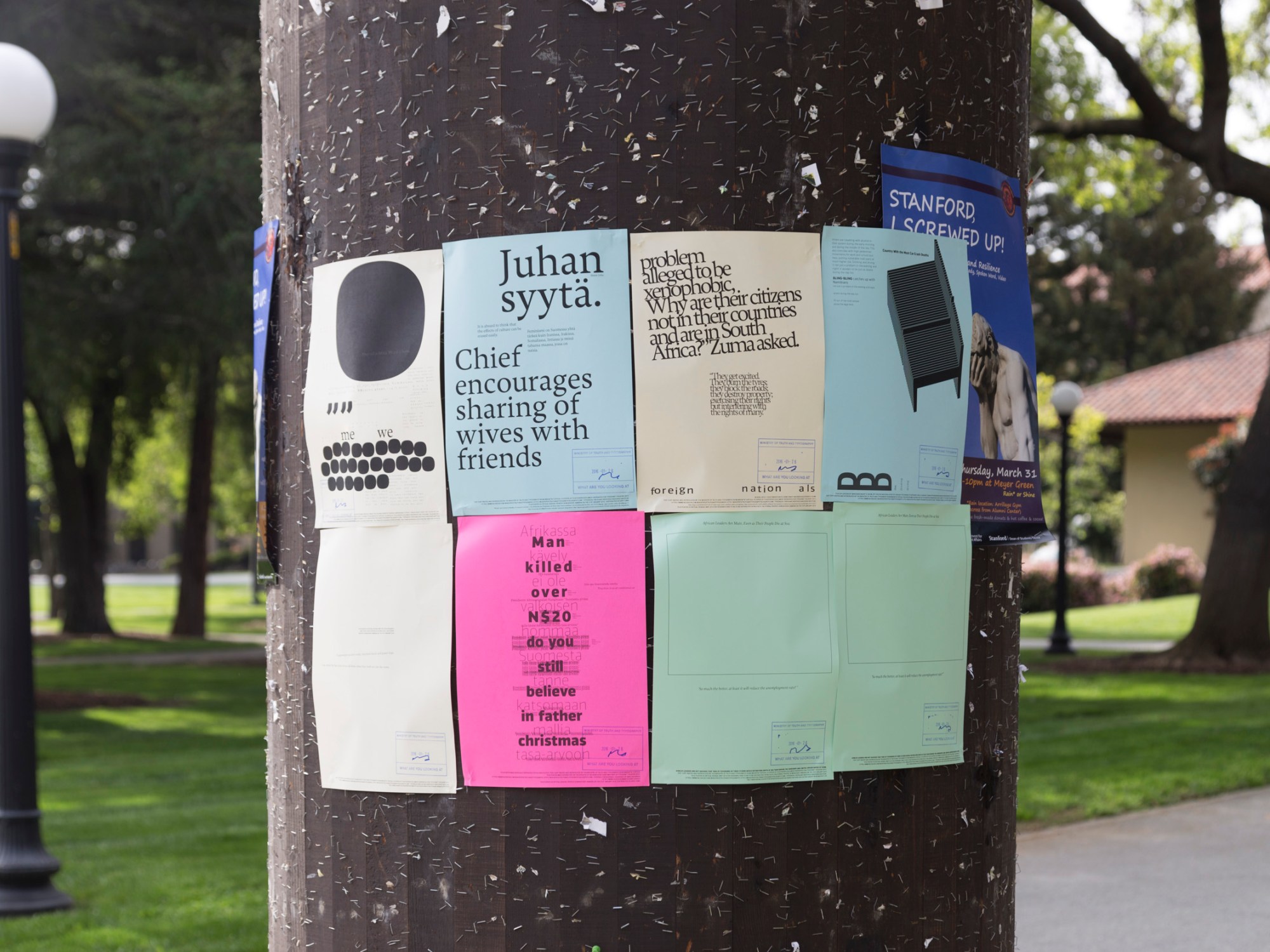


“Man killed for N20”, “Afrikassa kävely ei ole valkoisen hommaa”. This is written in the poster. Niina Turtola’s Ministry of Truth and Typography has landed on the Stanford University campus. Niina Turtola is a Finnish-born graphic designer, artist, and Phd student working on the margins. She is using graphic design as part of her artistic process, which discusses the violence and corruption in Namibian society, and on the other hand, may highlight conspicuous consumption and well-being in Finnish society. Signposting these phenomena isn’t safe in Namibian society, and showing the mirror to Finnish society is sure to cause a reaction.
Niina Turtola is working on the interface of two cultures. She is a Finnish woman in Namibia, and on the other hand, she is an expatriate who looks at Finland through analytical expat classes and knowledge, which makes you take two steps back when you look at your “homeland”. Her position becomes marginal in each direction.
Her posters made me think about fear and its marginalising effect. We Finns take safety as guaranteed. When I’m jogging alone in the dark Arctic nights of Rovaniemi, I’m only likely to encounter reindeer or another fellow dog walker. There is nothing to fear. Of course, time to time, even in our safe haven, something happens, and the further south you go, the more often this happens. Yet, when you live in Namibia, it’s sure that something will happen, especially if you don’t have the experience and ability to read the people and the cityscape. And what happens there may take your life.
Suppose I think about my history in Namibia, however short, with stays of months, half a year, or even just weeks, from time to time. In that case, I have experienced burglars coming in, shooting, theft, people coming into the car, shaking of followers while walking and all these with my son. I learned to live with an alarm system, panic buttons, fences, and barbed wire. First experiences were paralysing. I was terrified for a few nights, and I wondered how people can face this every day. But I also listened and tried to learn how to read the cityscape and people, and how to look after my bags, keys, money, credit card, children, and car doors, and how to be aware. I also learned that you don’t always get help from the officials or the police. They just don’t come.
In Lapland, I don’t need to be aware, and not even in Helsinki. It’s exceedingly rare in Helsinki that someone would kill you for two euros, which, on the other hand, is not so rare in Windhoek. At least, while I lived there for some years, it was safe to move about, even in the dark.
Niina Turtola’s posters make me think about fear and being afraid for your body and life. The feeling when you’re not safe and have to take extra measures every day, day, and night, using your senses to gauge if it’s safe or not. This marginalises you if anything. And, when you think about it, you don’t have to go so far to the dark nights of Windhoek or Helsinki. Sometimes this paralysing presence is in our relationships. So many women encounter domestic violence in each country. Then you don’t even have anywhere to go.
By Satu Miettinen
 margintomargin