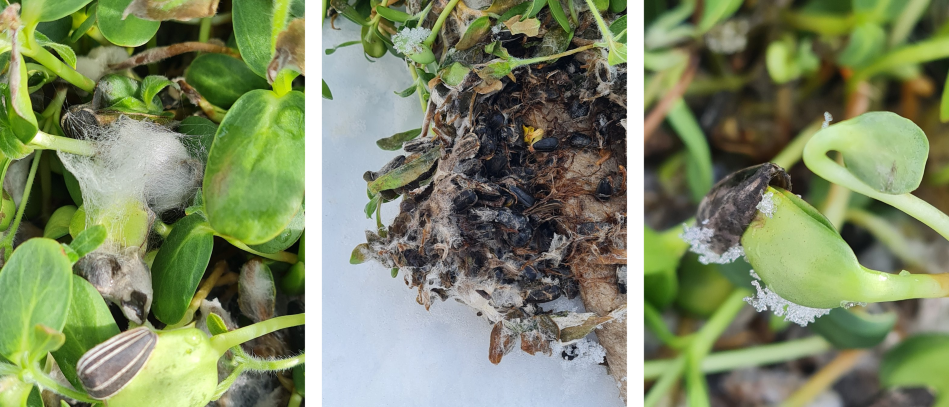
Bioart and biomimicry reveal that tipping points emerge through slow, decentralised, and often hidden processes driven by more-than-human agency. By working with living systems rather than dominating them, we learn to sense early shifts and design in ways that support resilience, rather than collapse. These lessons encourage a shift from anthropocentric control to symbiotic, process-based collaboration to navigate future systemic thresholds.

The theory of tipping points—critical thresholds where small changes can trigger major systemic shifts—can be meaningfully informed by bioart and biomimicry practices. In the BioARTech experiments, artists worked with more-than-humans (plants, environments) as co-authors rather than subjects. This collaboration showed that living systems are always in process, sensitive to conditions, and capable of radical transformations when small shifts (like slight environmental changes) occur. The Roots Stitching project, where sunflower seedlings wove wool together with their roots, demonstrated that non-human agents engage in slow, rhizomatic, cumulative actions that eventually create profound structural change—mirroring the way tipping points build through quiet, often unseen processes.
Biomimicry further sharpens this understanding by showing that natural systems operate through decentralized intelligence, resilience, and self-organizing behavior, all of which are key dynamics leading up to tipping points. Lessons from biomimicry teach that design and intervention strategies should embrace slow adaptation, symbiotic relationships, and respect for hidden processes rather than forcing rapid, anthropocentric solutions. Taken together, bioart practices and biomimicry insights suggest that recognizing and respecting the agency of more-than-humans—and learning to “design with” rather than “design for”—can better prepare us to sense, anticipate, and respond to approaching ecological and societal tipping points before collapse happens.
Melanie Sarantou, Amna Qureshi and Tarja Pӓӓkkӧnen
Sarantou, M., Qureshi, A., Pӓӓkkӧnen, T., (2024). Growth, Decay and Becoming: Insights from Bioart and Transformation Design. 24th DMI: Academic Design Management Conference, Design & Innovation at a Crossroad, Delft, Netherlands, 6-7 August 2024, pp. 1206-2018. https://www.dmi.org/page/ADMC2024Proceedings
 margintomargin