The incredible two-year journey from edge to edge is ending. I travelled thousands of kilometres by plane, train, bus, minivan and car, and every kilometre was worth it: from the Australian sunny beaches to the ice-cold edge in Murmansk, Russia.
My Trash Art Project started in South Australia. I collected trash items from the environment and stitched them together for an art piece called Maralinga. The piece was based on the stories of atomic weapons that were tested by the British in the Maralinga Aboriginal Reserve in the 1950s and 60s. Maralinga was exhibited in Finland at Arktikum in Rovaniemi during our project exhibition, ‘Every Margin Tells a Story’ in December 2016.
During the workshops in Rovaniemi and Murmansk, I collected trash from their rather chilly winter environments. The staff of MASU, Murmansk Arctic State University, also helped me with this task. I got some beautiful old Christmas and greeting cards from them. After the workshops, I returned to my hometown, Kuopio, in Finland, and started creating art pieces from my findings.
The art piece Hattara is made from trash in Rovaniemi. It is inspired by the Sámi people, who show their identity and status through their clothes and jewellery. Hattara is made for those who prefer to disguise or hide their identity. The word hattara comes from one of the Sámi languages and means: creepy laughing female goblin in the woods.


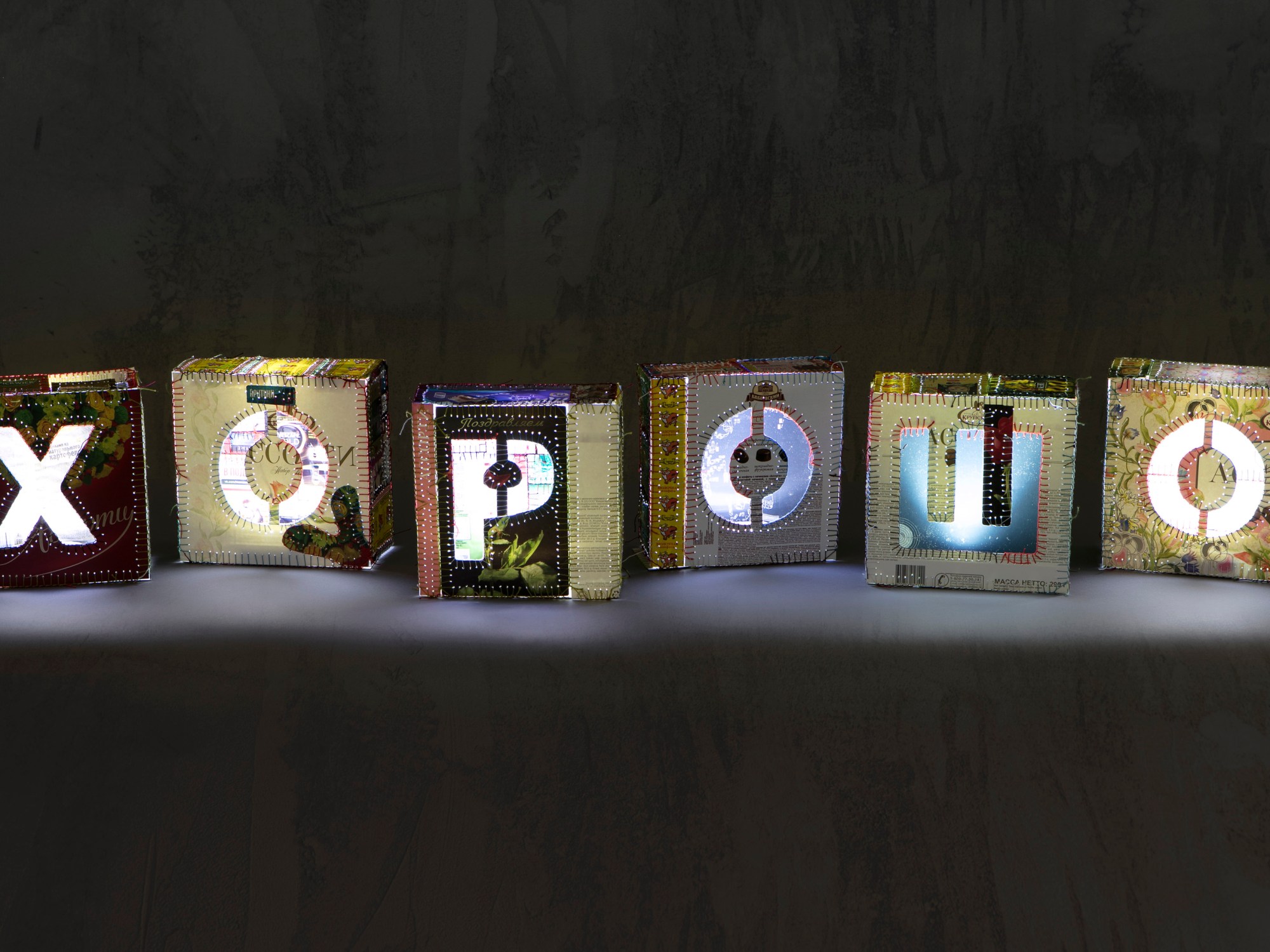
From the items I collected in Murmansk, I created an art piece called Хорошо (Haraso-Hyvä-Good). It is based on familiar Russian words, such as haraso, holodna, and others I heard there. My late mother used those words when I was a child. The shape of the art piece is based on the colourful and appealing neon lights in Murmansk. All three art pieces are now in the Naisia maailman laidalla exhibition in Helinä Rautavaara Museum in Espoo, Finland.
My aim in my work is to encompass the commentary on global consumerism. My art is site-specific, reflecting concrete events and encounters. Its materiality brings my subjective experiences to life for the viewer. I have always been using recycled materials in my art. The use of trash is a natural extension of my art practice. During this two-year project, I learnt to trust my own feelings and let them guide my art even more. I remember feeling a little insecure when I decided what my project was going to be: using trash from the environment to create art pieces. Luckily, the response of other women in the workshops and the exhibition audience has been encouraging – they have appreciated what I was doing.


During this project, I also developed a new workshop model called the Trash Art Project Workshop. These workshops are also site-specific, and the materials, such as trash, are collected from the surrounding space. The audience can take part in the workshop to create an art piece from the collected trash. The first Trash Art Project Workshop took place at the Satoa Goes Wild Street Food Festival in Kuopio in June 2017. The materials, including plastic cups and paper plates, were collected from the festival area. I was also working in South Africa with the San youth in July. There, we collected trash and created San symbols out of it for an installation that will be exhibited next year at Arktikum in Rovaniemi. The latest workshops took place at the Helinä Rautavaara Museum. A large amount of material was collected with the help of the museum staff, and the participants were mostly school children.
Two years ago, when this Women living on the edges of the world project started, my mother passed away. I am thankful to have had the opportunity to work with almost one hundred wonderful women from around the world and share our lives and stories. These women also gave me the comfort I needed in my sad situation. Something beautiful and unexpected happens to you, both as an artist and as a person, when you meet and work with other makers.
By Tarja Wallius
Photo credits: Petra Tiihonen / Alias Creative Studios
 margintomargin